The hidden cost of Cheap LED Lights in Reef Aquariums

Photo credit: Orphek
Why Cheap LED Lights Fail in Reef Aquariums (And What Actually Works Long-Term)
Cheap LED lights promise big savings and impressive specs on paper, but many reefers quickly discover disappointing coral growth, fading colors, nuisance algae, and premature failures.
While they might work for fish-only or soft coral setups, they often fall short for mixed or SPS-dominant reefs.
The problem with cheap reef lights isn’t always obvious at first.
By the time many reef keepers realize the limitations, they’ve already invested months, and often hundreds or thousands of dollars in the corals beneath them.
Here’s why cheap lights underperform, and how to choose lighting that delivers real results without wasting money.
1. Poor Spectrum Quality: “Junk Food” for Corals
PAR (Photosynthetically Active Radiation) numbers can be misleading.
Many budget lights use off-the-shelf LEDs (often low-Kelvin whites with heavy green output) that boost raw PAR readings, but deliver low PUR (Photosynthetically Usable Radiation).
Green wavelengths (500–580 nm) promote nuisance algae more than coral growth.
They lack sufficient UV/violet (390–420 nm) and balanced blue/red for optimal fluorescence, coloration, and physiology.
Result: Corals survive, but don’t thrive — poor polyp extension, slow growth, and muted colors.
PAR numbers tell only part of the story.
Corals respond not only to the amount of light they receive, but also to the quality of that light.
Orphek Natura iCon and Atlantik iCon are engineered to deliver broad, balanced spectra — 390–740 nm on the Natura iCon and comparably comprehensive full-spectrum coverage on the Atlantik iCon — covering the wavelengths corals utilize for photosynthesis, coloration, fluorescence, and overall health.
This includes:
- UV and violet wavelengths (390–420 nm) that support fluorescence and coloration
- Blue wavelengths essential for photosynthesis
- Carefully balanced red wavelengths that contribute to coral physiology without overwhelming the spectrum
- Reduced reliance on excessive green output that can inflate PAR readings without providing the same biological benefits
The result is a spectrum designed around coral biology rather than simply maximizing PAR numbers.
In practice, reef keepers often observe stronger coloration, better polyp extension, and healthier growth under a balanced spectrum than under higher PAR generated by a less refined light sourgenerated by a less refined light source.
2. Efficiency, Thermal Management & Long-Term Operating Costs
Power consumption alone does not determine lighting performance.
A more meaningful metric is how effectively a fixture converts electrical energy into biologically useful light for corals.
Many lower-cost fixtures require significantly more energy to achieve comparable output levels, resulting in reduced overall efficiency and higher operating costs over time.
Thermal management also plays a critical role in long-term performance.
Excess heat can accelerate LED degradation, reduce output stability, and shorten component lifespan.
Well-engineered cooling systems help maintain consistent light output while preserving the performance characteristics of the LEDs throughout their operational life.
Over several years of continuous operation, differences in efficiency, thermal design, and component quality can significantly impact both energy consumption and replacement costs.
Independent testing has consistently demonstrated Orphek’s ability to deliver high output and excellent efficiency, producing strong PAR and PUR values while maintaining comparatively low power consumption.
ucing strong PAR and PUR values, while maintaining comparatively low power consumption.
3. Build Quality, Durability & Lack of Upgradability
Budget fixtures commonly suffer from:
- Poor waterproofing (low IP ratings)
- Inadequate heatsinks leading to diode failure and dimming
- No meaningful upgrades — when performance drops, you replace the whole unit
Premium options (especially Orphek) use institutional-grade components proven in public aquariums, research settings, and professional installations (including Orphek’s Amazonas series specifically developed for public venues and large-scale exhibits).
Orphek’s modular plug-and-play design with hardware upgradability options (components, controls, and cross-generation compatibility on the Atlantik series) extends fixture life significantly at low cost.
4. Inadequate Coverage, Hotspots & Shadowing
Many cheap lights create intense hotspots directly below diodes with rapid PAR drop-off. This leads to:
- Uneven growth
- Shadowing on complex aquascapes
- Difficulty placing corals optimally
Better fixtures provide even spread and deeper penetration. Orphek Atlantik iCon excels here for large and deep tanks.
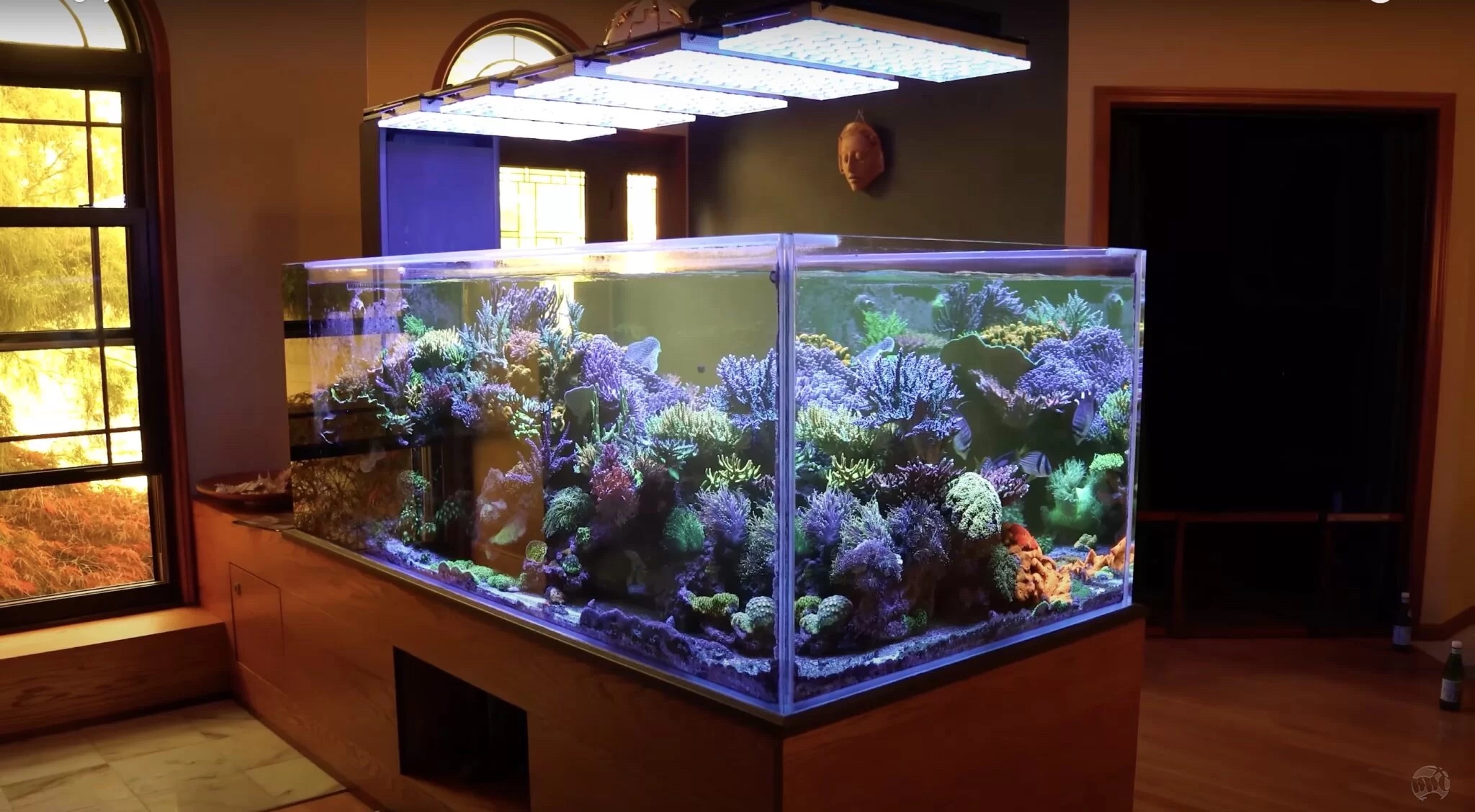
Photo credit: Orphek
Long-Term Cost Comparison
| Factor | Cheap/Budget LEDs | Premium Lights (e.g., Orphek) | Winner |
|---|---|---|---|
| Upfront Price | $100–$300 | $700–$1,200+ (check our current promotional prices!) | Budget |
| Efficiency (PAR/Watt) | Poor to moderate | Top-tier | Orphek |
| Annual Energy Cost | Higher | Lowest | Orphek |
| Lifespan | 2–4 years (fading/failures) | 7–10+ years with upgrades | Orphek |
| Total 5–10 Yr Cost | High (replacements + electricity) | Lowest (efficiency + upgradability) | Orphek |
| Coral Results | Softies/LPS only | Mixed to demanding SPS | Orphek |
For serious reefs, cutting corners on lighting is false economy.
There are real risks of expensive coral losses and repeated replacements.
Final Verdict: Invest in Quality for Better Results & Savings
Cheap lights often fail because they prioritize low price over the biology of corals.
Orphek stands out as a top long-term choice thanks to superior spectrum, efficiency, upgradability, and proven use in research and professional installations.
Ready to upgrade your reef? Focus on PAR maps, spectrographs, and real efficiency data instead of wattage or hype.
Your corals and wallet will thank you in the long run.
