From remarkable camouflage to astonishing intelligence, discover five reasons why one of the ocean’s most fascinating inhabitants continues to amaze us.
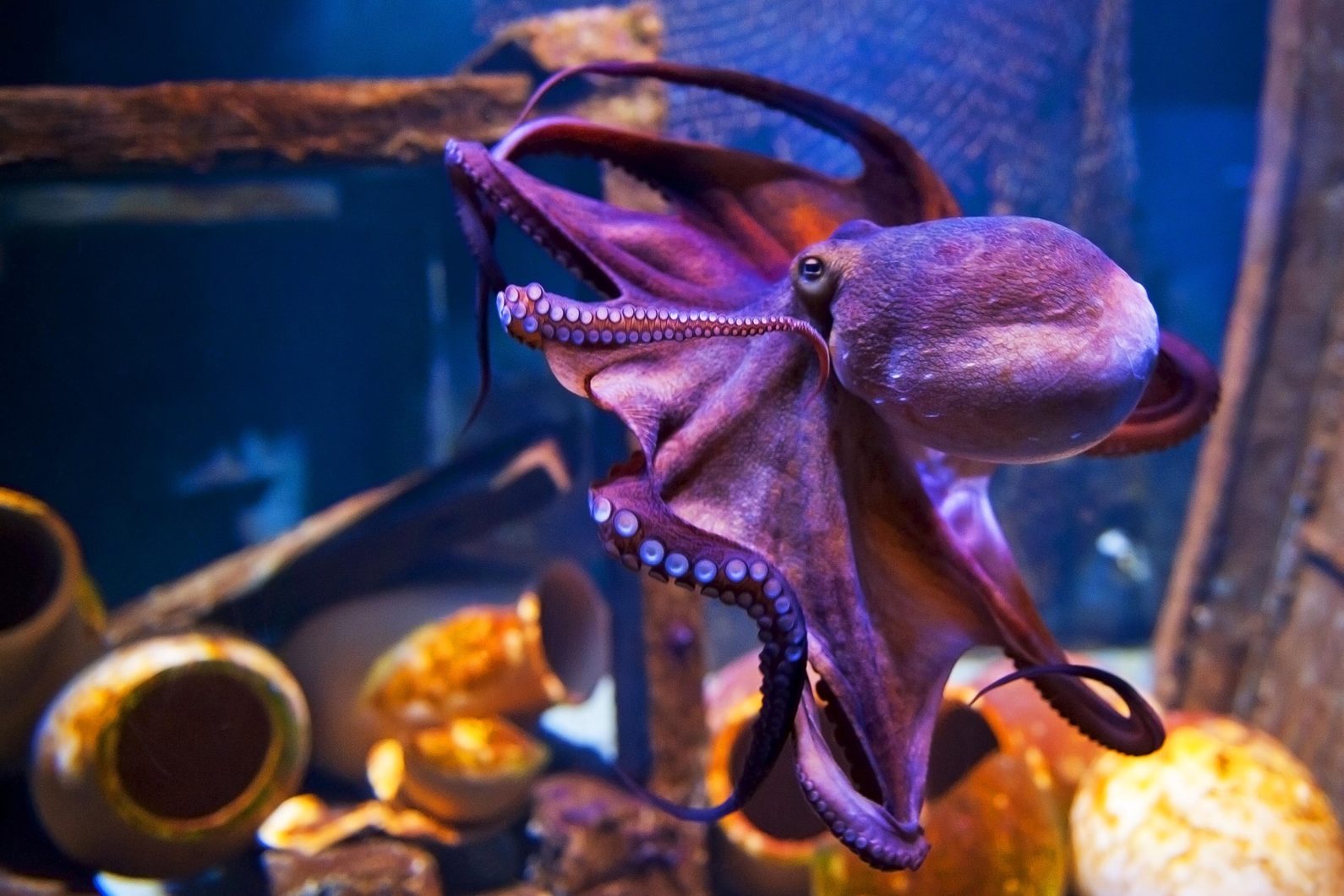
Octopus swimming in an aquarium with curled arms and visible suckers
Every year on October 8, we celebrate World Octopus Day, an opportunity to turn our attention to one of the most extraordinary creatures in the ocean.
Few marine creatures capture our imagination quite like the octopus. The more scientists observe these animals, the more they uncover behaviors and abilities that challenge what we think we know about life beneath the waves.
So, what makes the octopus so extraordinary? Here are five fascinating reasons to take a closer look:
A Master of Disguise
Imagine being able to change your appearance in seconds, blending almost seamlessly into your surroundings. For an octopus, this is a remarkable part of everyday life.
Specialized skin cells called chromatophores allow octopuses to change color, while other structures help them alter the appearance and texture of their skin.
In moments, an octopus can transform from a conspicuous animal into one that is remarkably difficult to distinguish from the rocks, sand, or reef around it. These transformations help octopuses avoid predators and approach prey without being noticed.
But there is an even more intriguing mystery: many octopuses appear to be colorblind, yet they can match complex visual backgrounds with extraordinary precision. Scientists are still investigating how their visual systems and skin respond to their surroundings.
Eight Arms, One Remarkable Mind
An octopus does not process the world in quite the same way we do. Its nervous system is distributed throughout its body, with a large proportion of its neurons located in its arms rather than its central brain.
This arrangement allows its arms to gather sensory information and perform complex movements with considerable independence. Each arm can explore, grasp, and investigate objects while the animal responds to its surroundings.
Octopuses have also demonstrated impressive problem-solving abilities. They can learn, remember, navigate puzzles, and manipulate objects to reach food or find shelter.
Their intelligence challenges the assumption that sophisticated behavior requires a backbone or a brain organized like our own.
The Ocean’s Unexpected Tool Users
Some octopuses do more than find shelter. They bring it with them.
The coconut octopus has been observed collecting discarded coconut shell halves and other objects, carrying them across the seafloor, and assembling them into protective hiding places when needed.
Transporting these objects can even make the animal more exposed while it moves. Yet the potential benefit of having a ready-made shelter makes the effort worthwhile.
This behavior is particularly fascinating because it involves collecting an object for future use, rather than simply using whatever happens to be available in the immediate surroundings.
Tool use is often associated with animals such as primates and certain birds. Observing it in an octopus reveals just how varied problem-solving strategies can be across the animal kingdom.
Three Hearts and Blue Blood
If the octopus already sounds extraordinary, its internal biology makes it even more remarkable.
An octopus has three hearts. Two pump blood through the gills, where oxygen is absorbed from the water, while the third circulates oxygenated blood around the body. And that blood is blue.
Unlike human blood, which relies on the iron-containing protein hemoglobin to transport oxygen, octopus blood uses hemocyanin, a copper-containing protein. When oxygen binds to hemocyanin, it gives the blood its characteristic blue color.
This oxygen-transport system helps octopuses function in aquatic environments, including cold waters where oxygen availability can be challenging.
Three hearts, blue blood, and a body capable of extraordinary flexibility: the octopus is a striking example of how evolution produces solutions very different from our own.
An Animal That Can Become Someone Else
Among the ocean’s most remarkable performers is the mimic octopus. Rather than simply blending into its surroundings, this species can change its coloration, posture, and movements to resemble other marine animals.
Depending on the situation, it has been observed adopting appearances resembling flatfish, lion fish, and sea snakes. These imitations are thought to help discourage potential predators.
What makes this behavior so fascinating is its apparent flexibility. The octopus does not rely on one fixed disguise; its behavior can vary according to the circumstances.
It is an extraordinary example of adaptation, in which appearance and movement become part of a survival strategy.
For the mimic octopus, survival can depend not only on where it hides, but also on what another animal believes it is seeing.
Meet the Giant Pacific Octopus at Den Blå Planet, Denmark
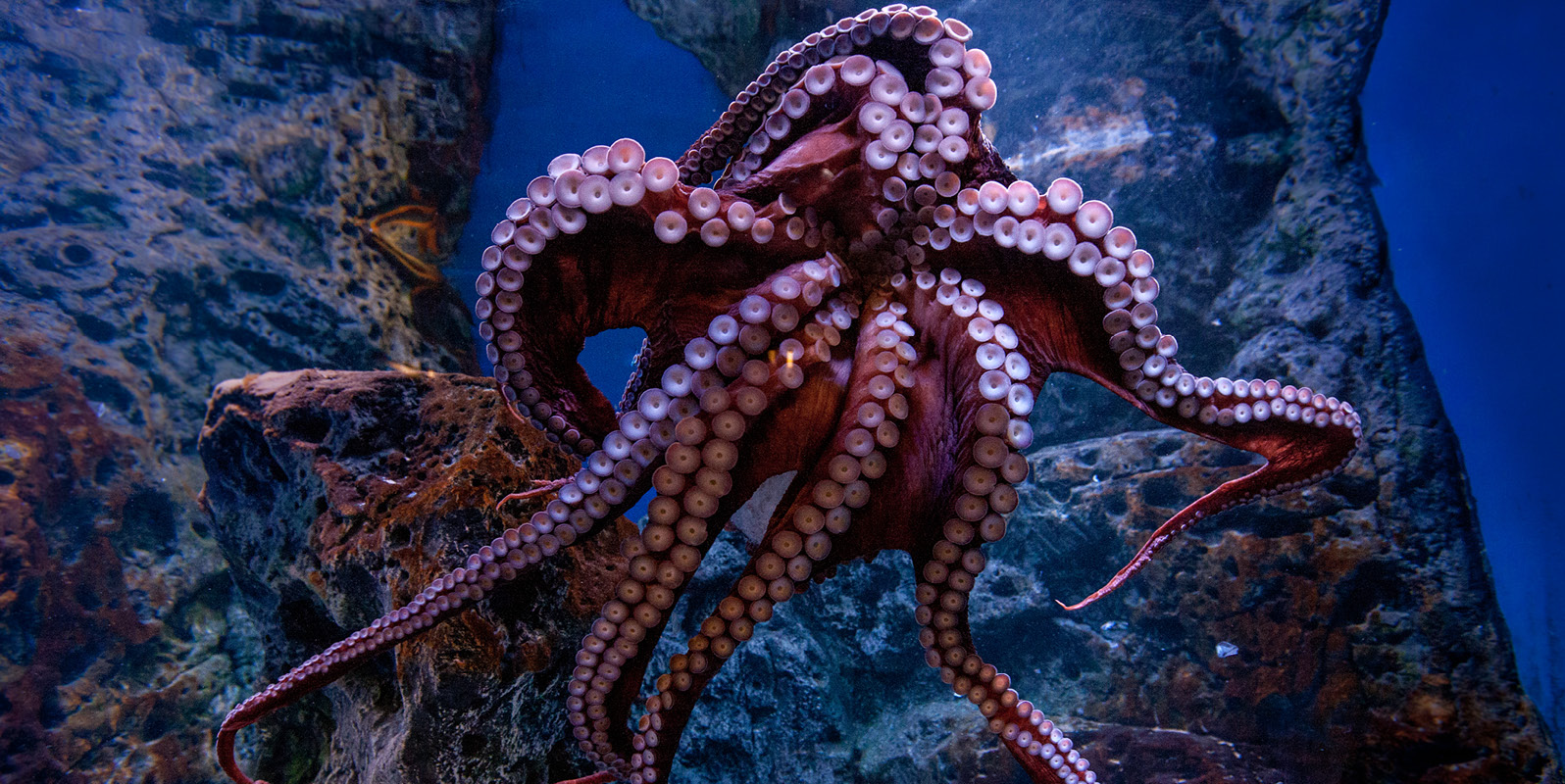
One of the fascinating creatures featured in the Big Five at Den Blå Planet, the National Aquarium of Denmark, is the giant Pacific octopus.
Measuring approximately 1.5 meters, this remarkable animal has nearly 2,000 suckers across its eight arms. Highly intelligent and surprisingly dexterous, it can change its skin color and texture to blend into its surroundings and even solve puzzles, such as opening a jar.
Curious, flexible, and exceptionally good at escaping, the giant Pacific octopus is a wonderful reminder that some of the ocean’s most extraordinary minds belong to creatures very different from ourselves.
A Reminder of How Much the Ocean Still Holds
The octopus is far more than an unusual-looking marine animal. It represents a different approach to intelligence, movement, camouflage, and survival, one shaped by an evolutionary history vastly older than our own.
Its abilities also remind us that the ocean is not simply a beautiful environment to observe. It is a complex living world, full of relationships, adaptations, and discoveries that continue to challenge our understanding of life.
World Octopus Day may come around only once a year, but the curiosity these animals inspire is worth carrying with us every day.
Because the more closely we look at the ocean, the more we realize how much remains to be understood, and how important it is to protect the extraordinary biodiversity that makes our blue planet so unique.
The ocean still has so many stories to tell. Sometimes, all we need to do is look a little closer.
At Orphek, our fascination with marine life goes beyond the page
We partner with public aquariums, research institutions, and marine facilities around the world, developing advanced, customized LED lighting solutions designed to recreate more natural lighting conditions and support the well-being of marine life in human care, including the extraordinary creatures that inspire our curiosity about the ocean.
Orphek has supplied extensive LED lighting solutions to this renowned public aquarium, including for reef exhibits housing octopuses and other fascinating marine life.
Photo credit: Den Blå Planet, the National Aquarium of Denmark.
Discover Orphek’s work with public aquariums and marine facilities worldwide →

“Together we protect Nature’s Biodiversity for generations to come”.