How to Build a Reef Lighting System That Grows With Your Aquarium
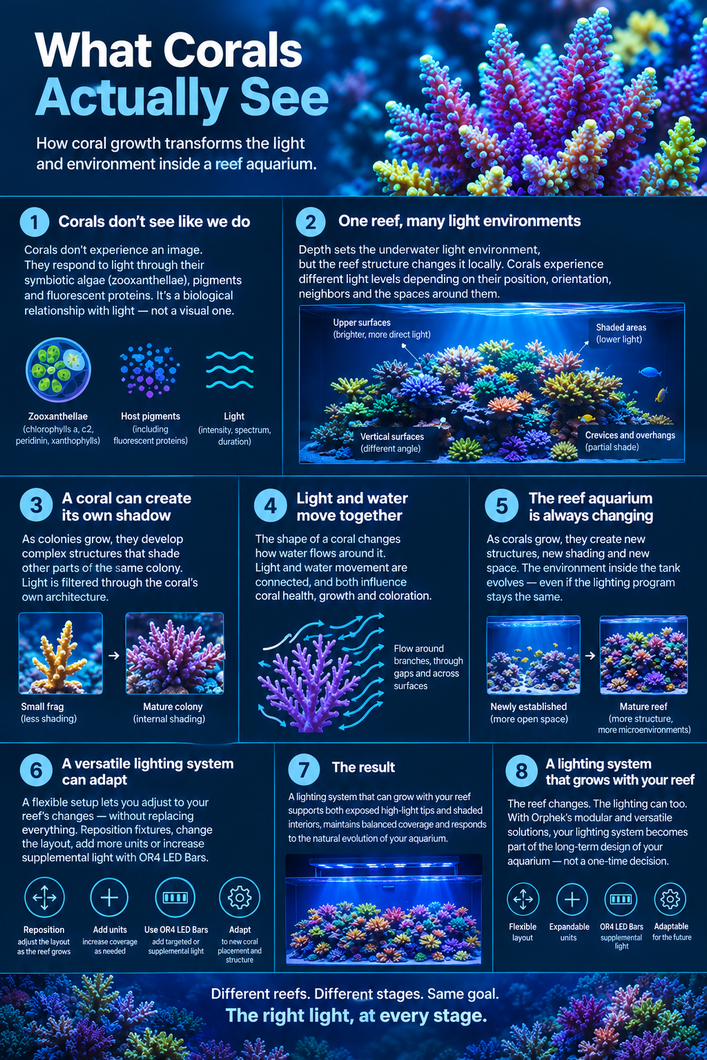
Coral growth changes more than the appearance of a reef aquarium. It changes the way light needs to reach it.
In this week’s post, we look at how to keep your lighting flexible as your reef evolves, and why the ability to adapt your setup can become just as important as the lighting itself.
A reef aquarium rarely stays the same for long.
Corals grow upward, outward, and into the spaces around them. A colony that once occupied a small area can eventually become a significant part of the aquarium’s structure.
New colonies are added, existing colonies are moved, and the balance between open water, rockwork, and coral changes continuously.
As the reef develops, the lighting arrangement above it may need to develop as well.
This is one reason a reef lighting system should not be viewed as a fixed installation.
The most useful lighting system is one that can adapt to the aquarium it is illuminating.
The Layout Matters
Two aquariums can have the same dimensions and still require very different lighting arrangements.
The coral collection, aquascape, colony size, available swimming space, and the way the reef is intended to develop all influence how light needs to be distributed.
A densely populated reef may benefit from several fixtures distributed across the aquarium.
Another tank may work with a larger central fixture. A long aquarium may lend itself naturally to a linear arrangement of LED bars.
The objective is not to find one universal layout. It is to create a lighting arrangement that works with the structure of the reef.
Three Reefs, Three Lighting Approaches
Real reef aquariums make this particularly clear.
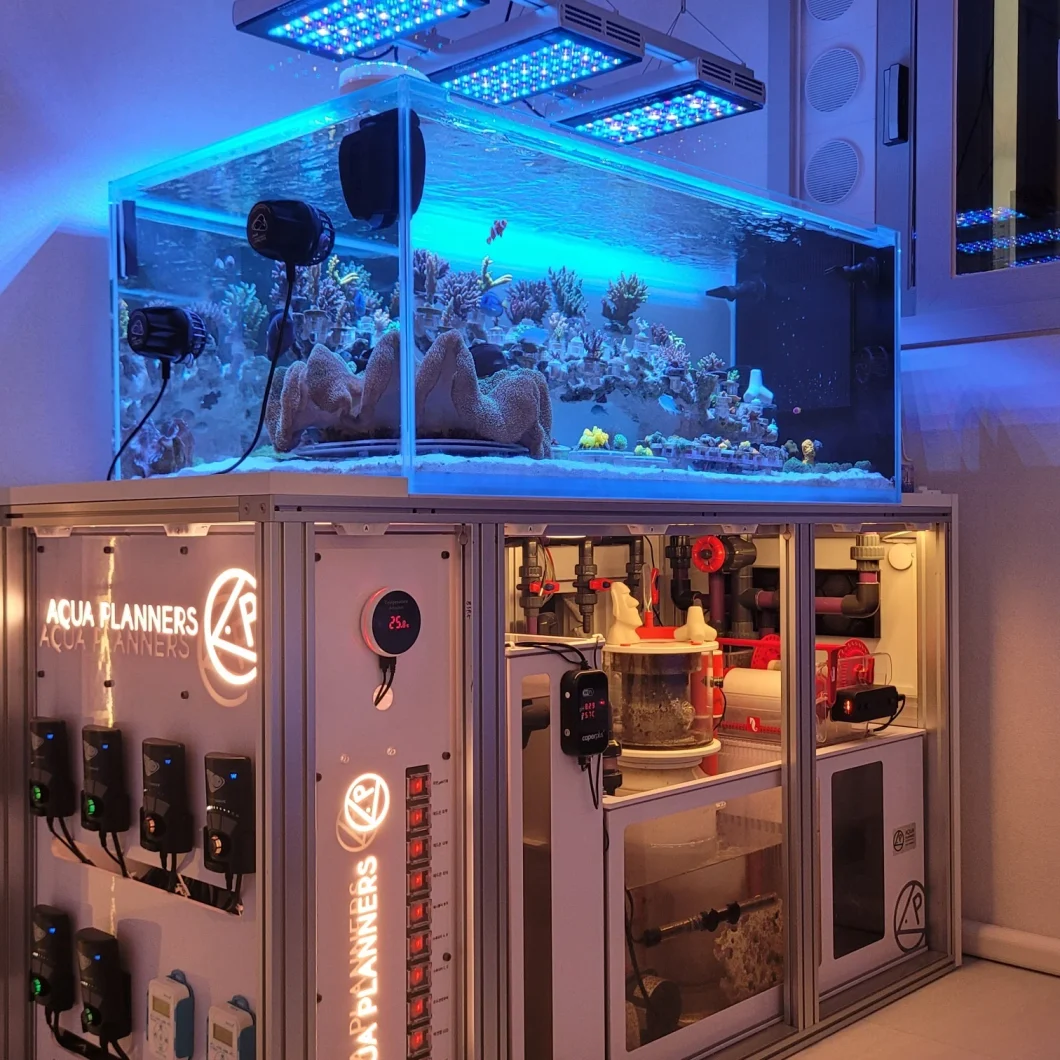
Three Natura iCon fixtures — distributed light across a mature reef:
This aquarium uses three Orphek Natura iCon fixtures positioned across the tank.
The reef has developed into a dense coral structure, with colonies occupying much of the available space and creating multiple levels throughout the aquarium.
The three-fixture arrangement follows the footprint of the aquarium rather than concentrating the lighting in one central position.
It is a good example of how multiple fixtures can work together as a single lighting system.
As the reef develops, their positioning can also be considered in relation to coral placement and the areas of the aquarium that require coverage.
The lighting follows the reef’s footprint rather than forcing the reef to follow the lighting.
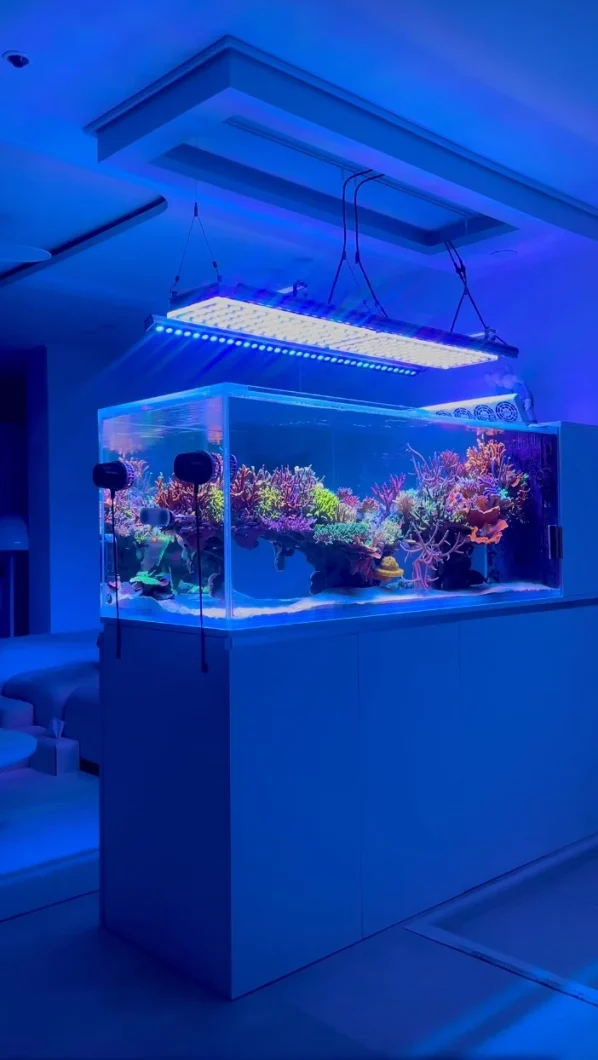
Atlantik iCon + supplemental OR4 — a primary system with additional light:
The second aquarium demonstrates another approach.
Here, an Orphek Atlantik iCon provides the primary lighting, complemented by supplemental OR4 LED lighting.
The reef has a broad and highly developed coral structure, with substantial colonies extending across the aquascape while open areas remain around them.
This configuration shows how the main lighting system does not necessarily have to do everything alone.
Supplemental lighting can be introduced to complement the primary fixture and adapt the overall lighting arrangement to the aquarium’s structure.
It is another way of building flexibility into the system: establish the primary lighting, then refine the arrangement where the reef calls for it.
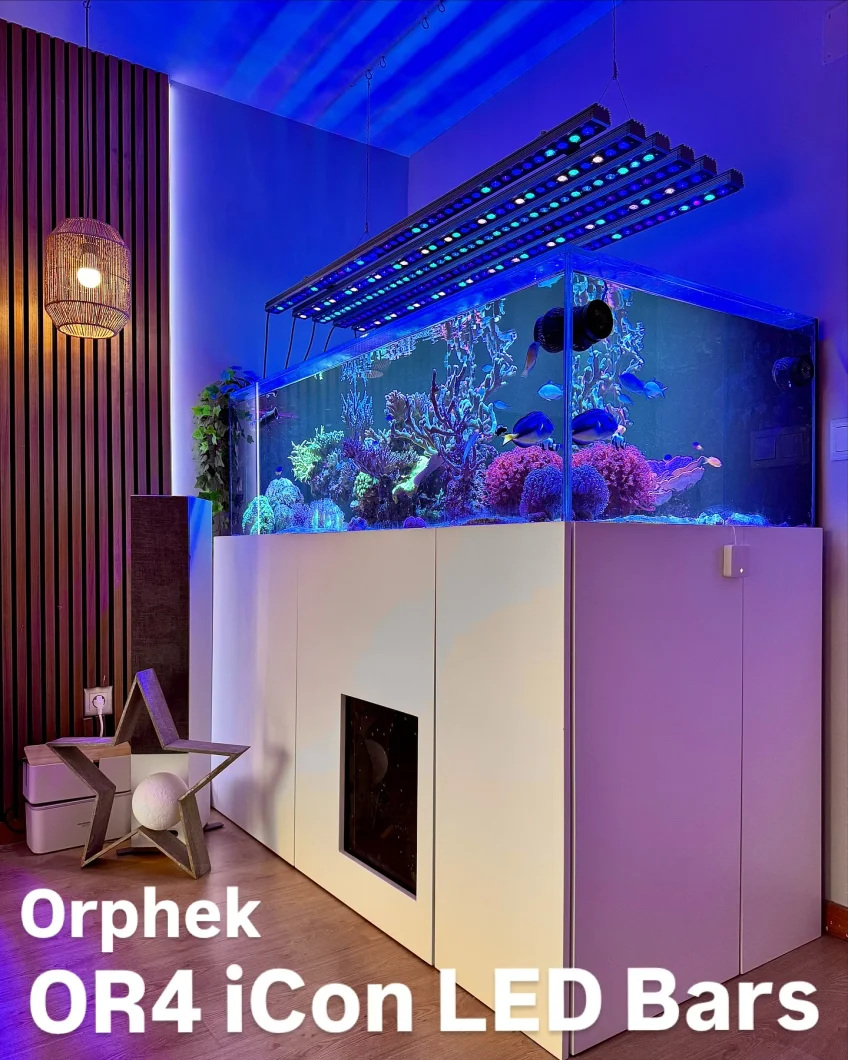
Six OR4 150 LED Bars — a modular linear approach:
The third aquarium takes a very different approach, using six Orphek OR4 150 LED Bars arranged in parallel above the tank.
The long, linear arrangement follows the dimensions of the aquarium and creates a lighting system built from multiple individual units.
The reef beneath it has also developed into a substantial three-dimensional structure, with large coral colonies distributed across the aquascape.
This is where the modular nature of LED bars becomes particularly interesting.
The number of bars, their spacing, and their position can all be considered as part of the overall lighting layout.
Rather than treating the lighting fixture as one fixed object, the system itself becomes a configurable element of the aquarium design.
A Reef Aquarium Is a Moving Target
When an aquarium is first established, the space between the light source and the coral structure is relatively open.
Years later, it may look completely different.
Colonies occupy more of the available space.
Their surfaces become more complex and some areas that were once directly exposed are now partially surrounded by other colonies or rockwork.
This does not mean that the original lighting system has become unsuitable.
It means that the relationship between the lighting system and the reef has changed.
That distinction is important.
Instead of replacing an entire lighting system every time the aquarium develops, a modular approach allows the lighting configuration to develop alongside it.
Start With a System You Can Expand
A practical reef lighting system should allow more than one path forward.
If the aquarium becomes more densely populated, additional fixtures can be added.
If coral placement changes, existing fixtures can be repositioned.
If a particular section of the aquarium requires additional coverage or intensity, supplemental lighting can be introduced without redesigning the entire installation.
This approach is particularly useful for large or evolving reef aquariums, where the final coral structure may be impossible to predict when the initial lighting system is installed.
With Orphek systems, the lighting layout can be adapted as the aquarium develops.
Additional units of the same lighting solution can be added when greater coverage is required, while the position of existing fixtures can be adjusted to suit changes in coral architecture.
The result is a lighting system that can grow with the reef rather than being defined by its first configuration.
Tank: @redsea.aquatics Reefer 1000s
Lights: 4x @orphek.led Naturas
When the Main Lighting Is Not the Whole Story
There are also situations where the primary lighting system provides the main illumination, but additional light is useful.
This is where supplemental LED bars can become particularly practical.
Orphek OR4 LED Bars can be used to add additional illumination to specific areas of an aquarium without replacing the primary lighting system.
They can be positioned alongside the main fixtures to extend coverage, support areas that have become more heavily populated, or complement the existing layout.
This creates another level of flexibility:
The main system establishes the foundation.
Supplemental lighting can refine it.
Rather than requiring every lighting requirement to be solved by increasing the number of primary fixtures, an aquarium can combine different lighting elements according to its structure and objectives.
The Advantage of Changing the Layout
A lighting system is often installed according to the aquarium as it exists on installation day.
But the reef that occupies that aquarium six months, one year, or several years later may be very different.
Being able to change the layout gives the aquarist another tool.
- Fixtures can be repositioned according to coral growth.
- Additional units can be introduced as coverage requirements increase.
- Supplemental LED bars can be added where the existing arrangement needs reinforcement.
This is especially relevant for reef aquariums where coral colonies are intentionally allowed to develop into substantial structures rather than being maintained at a fixed size.
The lighting system does not have to dictate the final architecture of the reef.
It can adapt to it.
One System, More Possibilities
(Comment taken from Orphek Instagram:“Makaira Reef at its best.
Intense colors, corals growing, fish active and the reef is ever maturing. After so many adjustments, changes, and evolution, it’s pretty cool to look at the tank and see everything come together.
One of those moments when you just want to stop and watch. 🪸”)
This is a great example of a reef evolving over time captured in this video by its owner.
After sharing the many adjustments and changes that shaped the aquarium, he described the result: “Intense colors, corals growing, fish active and the reef is ever maturing.
After so many adjustments, changes, and evolution, it’s pretty cool to look at the tank and see everything come together.” His final thought perhaps says it best: “One of those moments when you just want to stop and watch.”
A growing reef does not always require a completely new lighting system. Sometimes it requires a different arrangement, greater coverage, or additional light in specific areas.
This is where a versatile lighting system becomes valuable.
Orphek offers several ways to build and adapt reef lighting.
Natura iCon and Natura iCon MAX provide complete reef lighting in a single fixture, while OR4 iCon LED Bars offer a modular approach that can be used on their own or alongside other lighting solutions.
OR4 bars can also be added progressively as an aquarium develops.
The layout itself can also change.
Fixtures can be repositioned, spacing can be adjusted, and additional units of the same solution can be introduced when the reef expands or becomes more densely populated.
The important point is that there is no need to treat the original lighting arrangement as permanent.
Start with the solution that fits your aquarium today. Keep the flexibility to adapt it as your reef develops.
If you are still deciding which Orphek lighting solution is appropriate for your aquarium, see our guide “How to Choose the Right Reef Aquarium Light” for a closer look at coral requirements, tank dimensions, and the different lighting configurations available:
The Reef Changes. The Lighting Can Change With It.
There is no single final configuration for a growing reef aquarium.
- The corals continue to develop.
- Their positions change.
- New colonies are introduced.
- Open areas become populated.
The visual and biological architecture of the aquarium evolves.
The lighting system should have the same freedom.
A versatile lighting installation allows the aquarist to respond to those changes without starting again from zero.
Build the lighting system for the reef you have.
Keep the flexibility to adapt it to the reef you will have.
That is the advantage of a modular approach: the lighting does not have to remain static while the reef continues to grow.
Ready to choose your lighting?
As your reef evolves, your lighting system can evolve with it.
Explore Orphek reef lighting solutions in our online shop, and before choosing your setup, take a look at our guide to [How to Choose the Right Reef Aquarium Light] for a closer look at aquarium dimensions, coral requirements, and the different lighting configurations available.

“Together we protect Nature’s Biodiversity for generations to come”.